Human Rights
Fundamental Approach
Under its mission of “Staying close to our customers and enriching their lives,” the Daihatsu Group positions respect for human rights and diversity of all stakeholders as a key pillar of management, respects the United Nations Guiding Principles on Business and Human Rights, supports Guiding Principles on Business and Human Rights, and advances initiatives to uphold human rights.
As part of these efforts, the Daihatsu Group, including consolidated subsidiaries, has established a human rights policy. By adhering to this policy, the Group works to create workplaces and a corporate culture where every officer and employee can work happily, while also collaborating with business partners and local communities to promote the establishment of sustainable supply chains.
Commitment for the Respect for Human Rights
The Daihatsu Group respects human rights based on the following international declarations, conventions, and other relevant instruments, supports the Guiding Principles on Business and Human Rights, and works toward putting them into practice.
- ・United Nations Universal Declaration of Human Rights
- ・United Nations International Covenant on Civil and Political Rights
- ・United Nations International Covenant on Economic, Social and Cultural Rights
- ・ILO Declaration on Fundamental Principles and Rights at Work
When local laws and regulations in the countries where the Daihatsu Group conducts business activities differ from international human rights norms, we will strive to adhere to the higher standard of the two. If there is a conflict between the standards, we will seek ways to respect the international human rights principles.
This policy is positioned as the highest-level human rights policy that every individual working within the Daihatsu Group must follow.
The policy applies to all officers and employees of the Daihatsu Group, and the Group also expects all business partners, including suppliers and sales companies, to understand and act in accordance with its principles.
Respect for Human Rights Across the Supply Chain
Supplier Sustainability Guidelines
The Supplier Sustainability Guidelines establish “Human Rights and Labor” as an item that all suppliers are expected to comply with. The Guidelines call for suppliers to conduct their business activities under principles such as nondiscrimination, prohibition of both child labor and forced labor, provision of appropriate wages and working hours, and creation of safe and healthy working environments. Daihatsu also asks its suppliers to promote the implementation of the Guidelines with their suppliers. In doing so, we strive to promote and spread our human rights initiatives to all corners of our supply chain.
Initiatives to Combat the Use of Conflict Minerals
In 2010, the Dodd–Frank Wall Street Reform and Consumer Protection Act was enacted in the U.S. It requires that companies listed on U.S. stock exchanges disclose information regarding conflict minerals (tantalum, tin, tungsten, and gold) used in their products. The act seeks to prevent armed groups in the Democratic Republic of the Congo and neighboring countries from generating funds through mining carried out by child labor, forced labor, or other inhumane means. As a member of the Toyota Group of companies, Daihatsu seeks to realize responsible procurement of minerals and, to this end, is working together with its suppliers.
Education Related to Human Rights
Fundamental Approach
Daihatsu implements training for all employees regarding human rights issues, non-discrimination, and open and honest dialogue. Through training, we ensure that all employees are thoroughly aware of the importance of respecting the human rights of all people involved in Daihatsu’s business, including business partners and customers, and that employees conduct business with consideration for the human rights violations that they could be indirectly involved in or contributing to.
Initiatives
Activities for Raising Human Rights Awareness
Daihatsu has been inviting all employees at its sites in Japan to submit human rights slogans every year since the late 1970s and presenting awards during Human Rights Week in December in order to make human rights feel more personal.
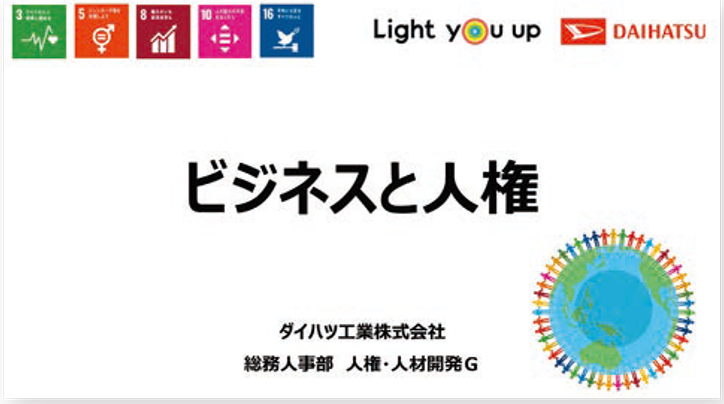
Training
Through education and training, Daihatsu promotes understanding and awareness of human rights, helping prevent discrimination and harassment caused by prejudice. The Group also carries out practical initiatives to promote respect for human rights throughout its business activities, including among business partners.
| Name of Training | Subjects | Overview |
|---|---|---|
| Training for New Employees | New employees | Promotes proper understanding of human rights and behavior based on mutual respect. |
| Compliance Training | All employees promoted to supervisor or higher New employees | Reinforces awareness of internal controls that prevent human rights violations. New employees also attend lectures delivered by Audit & Supervisory Board members. |
| Diversity Training | Newly appointed core staff | Creating positive workplace environments that value diversity. |
Corrective Action Process
We have established and operate a Harassment Consultation Desk where employees can file a report or consult with staff in the event that they discover any kind of harassment or other behavior that violates human rights in the course of business activities.
We established a department at each domestic office that is assigned responsibility for the Harassment Consultation Desk, where several personnel at that department serve as harassment consultants. When someone comes for consultation or to file a report, harassment consultants collect information and report to the General Manager of the Human Resources Division, who is the top authority responsible for harassment cases for the whole company. After that, the harassment consultants, Human Resources Division, and Safety and Health Care Department will work together toward resolution of the issue.
Similar types of consultation are also accepted by Labor Union General Consultation Desks, which are set up by various branches of labor unions, and the Employees’ Voice Helpline website, which is run by Daihatsu’s Audit Division.