Daihatsu’s Car Creating
Fundamental Approach
The first thing needed in order to reduce CO2 emissions is to minimize the amount of energy required while driving. Daihatsu advances environmentally conscious car creating by refining lightweight, compact vehicle bodies and highly efficient powertrains. Because the vehicles are small, required performance can be enhanced efficiently while reducing the amount of materials and energy used. Going forward, Daihatsu will continue working toward sustainable compact mobility through technological advancements, including electrification.
Supporting this approach to car creating are the principles of “high-quality but affordable products,” “mastering the smallest details,” and “providing advanced technologies to everyone.” The Daihatsu New Global Architecture (DNGA) serves as the foundation that consistently brings these principles to life across planning, development, purchasing and production. Starting with customer feedback, Daihatsu identifies the functions and performance that are truly needed and pursues sustainable compact mobility by developing vehicles from mini vehicles to A-segment and emerging-market B-segment models under a shared design philosophy.
DNGA (Daihatsu New Global Architecture)
Based on the core concepts of high-quality but affordable products, mastering the smallest details, and providing advanced technologies to everyone, Daihatsu engages in car creating that is close to customers’ lives. We have lowered the threshold for purchasing an automobile, thereby broadening the market base.
The Daihatsu New Global Architecture (DNGA) is a new method of creating cars intended to achieve these concepts. With the opinions of customers as our starting point, DNGA incorporates the business structures for carrying out Daihatsu’s unique car creating and the strategies for achieving this in all processes of car creating including planning, development, purchasing, and production. In the case of advanced technologies, such as electrification, automated driving, and connectivity, we will create sustainable compact mobility by developing automobiles based on common design concepts from segment A to segment B in markets in emerging countries, with mini vehicles as the starting point.
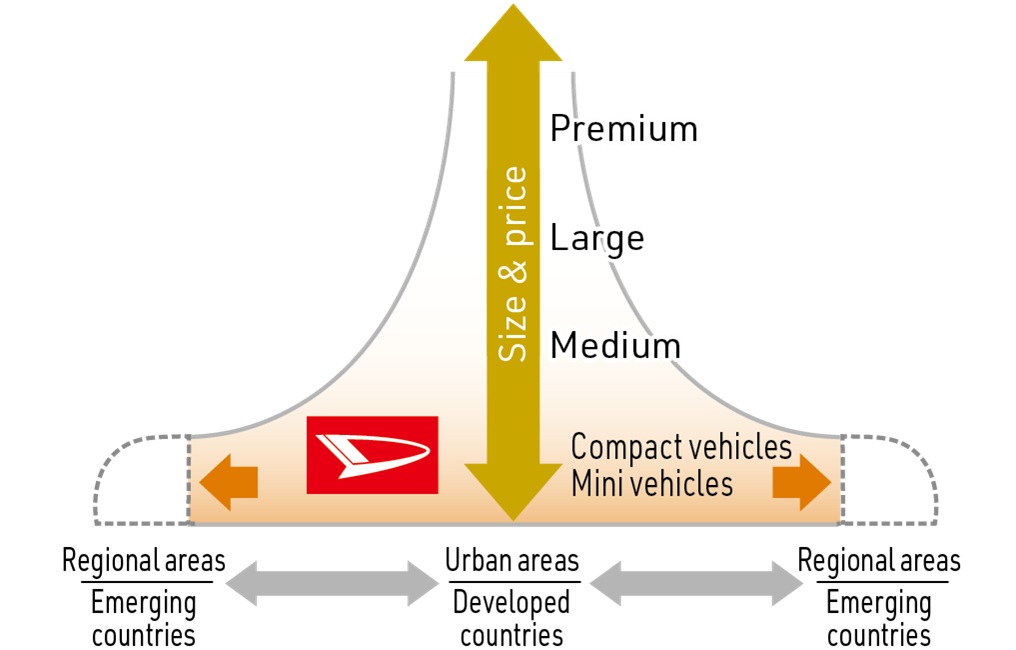 Daihatsu’s car creating is based on the idea of lowering the hurdles to purchasing an automobile and expanding the market base to senior customers, regional areas, and emerging countries
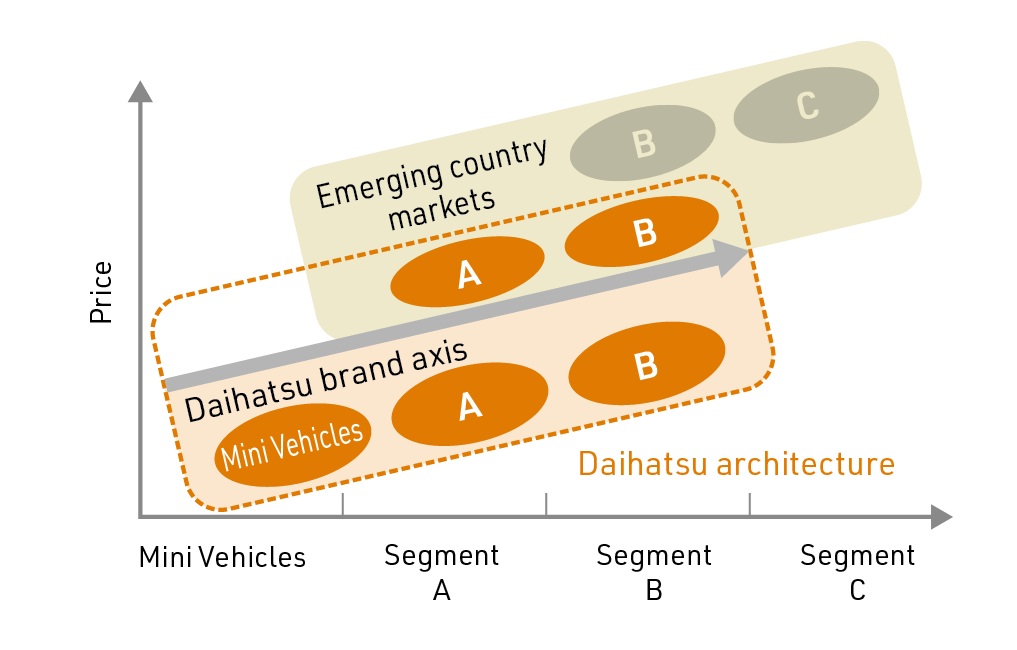 Daihatsu conducts business in segments that are close to customers and is developing automobiles based on common design concepts from segment A to segment B in emerging countries with mini vehicles as the starting point
Evolutionary Body
The new DNGA platform adopts a new design for suspension geometry* in the pursuit of stability and driving comfort that are superior to those of other vehicles in the same class. The structure has been optimized with electrification compatibility in mind, achieving both reduced weight and high rigidity. The ability to pursue overall optimization within limited space and weight is a unique strength of compact vehicles. Daihatsu will continue leveraging this strength to further evolve the performance characteristics that define Daihatsu vehicles.
* The placement of the suspension, which has a substantial impact on vehicle performance
Evolutionary Powertrain
The powertrains used with DNGA are optimized for each model to balance environmental performance and driving performance. Through technologies such as engines with enhanced combustion efficiency, new CVTs, and compact, simple series-type strong HEV systems, Daihatsu pursues efficient performance suited to compact vehicles.
Daihatsu will continue advancing electrification technologies suited to the compact mobility solutions that define the brand.