Management of Environmental Load Substances
Chemical Substances
Fundamental Approach
Daihatsu investigates and manages chemical substances contained in purchased materials and parts at the point of entry, confirming that they do not contain prohibited substances specified by laws, regulations, or internal standards.
Initiatives
Strengthening Management Across the Entire Supply Chain
Chemical substances contained in purchased parts are managed through IMDS1 in order to comply with the chemical substance regulations of each country.
Materials used in production processes and business sites are managed through PRTR-WORLD2 to ensure compliance with the regulations of each country, while also monitoring the amounts of regulated chemical substances released and transferred and properly reporting them to government authorities.
We also provide regular information sharing and support to our affiliated companies in Japan and around the world to enable them to perform chemical substance management at the same level as Daihatsu.
In order to ensure that our suppliers also understand the importance of chemical substance management, we use selfdiagnostic sheets created by an auto industry organization to monitor management levels and pursue improvements thereof.
1. International Material Data System: A material data system for the automobile industry
2. PRTR-WORLD: A system that supports administrative reporting for Pollutant Release and Transfer Register (PRTR) submissions and checks compliance with domestic and international laws and regulations (provided by Hitachi, Ltd.).
Regulation and Standards
| All Business Sites |
|
|---|
Prevention of Air Pollution
Fundamental Approach
Daihatsu properly manages and reduces environmental load substances in our production activities in accordance with the Environmental Action Plan and all relevant laws and regulations.
The Air Pollution Control Act sets out regulatory exhaust gas values for every type of facility. In order to prevent exhaust gases from our plants from causing air pollution, Daihatsu regularly measures and monitors exhaust gases generated by boilers and heaters, and ensures that both SOx and NOx concentrations remain significantly below regulatory values.
Initiatives
Initiatives to Reduce VOCs
With regard to atmospheric emissions of VOCs3, which are a cause of air pollution, we have carried out a variety of activities in accordance with the Environmental Action Plan aimed at reducing emissions volumes in the painting process, which accounts for the majority of VOC emissions. These include automating painting processes to improve coating efficiency, robotization, the use of electrostatic processes, and the recovery of thinners used to clean equipment. To drastically reduce VOC emissions, we are switching middle and top paint coats to water soluble paint at the Kyoto (Oyamazaki) Plant and the Daihatsu Motor Kyushu Co., Ltd. Oita (Nakatsu) Plant. We are also addressing chemical substances in production activities by complying with all relevant laws and regulations to ensure that we do not use banned substances.
3. Volatile Organic Compounds: Common VOCs include toluene, xylene, and other substances found in paints
Environmental Measurement Certification Site (Registered with Osaka Prefecture)
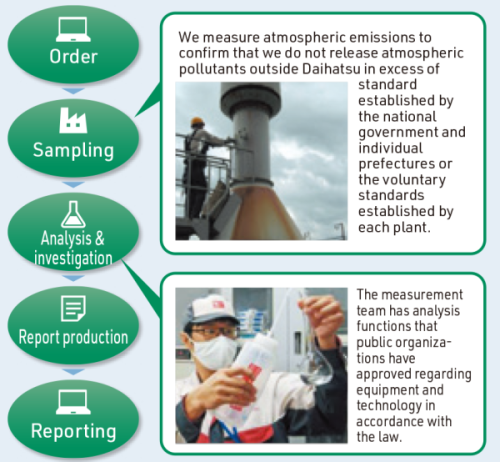
Osaka Prefecture registers Daihatsu as an environmental measurement certification site, which can accurately measure concentration of pollutants in water, air, and soil and publicly verify the results. This role is performed by the internal department responsible for environment measurements. They conduct sampling and chemical analysis and work in collaboration with each business site to prevent environmental abnormalities so that the various gases emitted and harmful substances in waste water generated during Daihatsu’s business activities do not exceed statutory standards. In addition, qualified personnel take measurements in work environments to protect the health of employees.
Business Flow
Regulation and Standards
| Head (Ikeda) Plant |
|
|---|---|
| Kyoto (Oyamazaki) Plant |
|
| Shiga (Ryuoh) Plant |
|
| Daihatsu Motor Kyushu Co., Ltd. Oita (Nakatsu) Plant |
|
Water Resources
Fundamental Approach
To minimize the effect on the water environment from our business activities, the Daihatsu Group is taking various measures to reduce water usage and recirculate and reuse water by purifying waste water.
Initiatives
Reduction of Water Usage
The Daihatsu Group is implementing water usage reduction measures at our vehicle production sites with a focus on painting processes. In the pretreatment and electrodeposition cleaning processes, we strive to ensure that water used in the cleaning process is effectively reused, thereby reducing water usage. In addition, we have developed and introduced an innovative cardboard filter-type dry booth for the painting process, and are working to reduce the amount of water used by replacing the conventional paint collection method that uses a water shower (gas-liquid mixture) with a dry filter*. As a result of these efforts, the amount of water used per vehicle, which was 6 m3 in 1995, has now been reduced to less than half. Going forward, we will pursue SSC (simple, slim, and compact) vehicle manufacturing even more and work to minimize water usage, thereby contributing to the conservation of water resources. At the same time, Daihatsu works to identify and appropriately manage risks associated with water use while taking into account regional characteristics such as the location of each site and local water resource conditions.
* This technology won the Machine Promotion Award presented by the Japan Society for the Promotion of Machine Industry in December 2022.
Purification and Reuse of Waste Water
At the Shiga (Ryuoh) Plant, Daihatsu has built the Aqua Center—a large-scale plant waste water purification facility—to guarantee the quality of water discharged into Lake Biwa. The Aqua Center purifies plant waste water to an almost drinkable level before discharging it into the lake. The Shiga (Ryuoh) Plant reuses water purified at the plant’s waste water processing facilities for its wet dust collectors. Our production bases in Indonesia and Malaysia take the greatest care to ensure that their plant waste water has no impact on downstream drinking water collection sites.
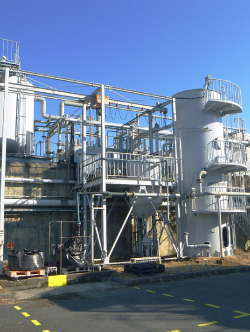 Shiga (Ryuoh) Plant Aqua Center No.3
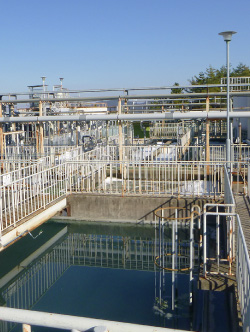 Waste water after it has been purified at the Aqua Center
Standards for Waste Water
At all plants, the Daihatsu Group sets voluntary standards that exceed those set by the national and local governments and discharges waste water only after it is purified to a sufficiently clean level.
We also work continuously to maintain and manage water quality while taking into consideration the characteristics of discharge destinations and local water environments.
Regulation and Standards
| Head (Ikeda) Plant |
|
|---|---|
| Kyoto (Oyamazaki) Plant |
|
| Shiga (Ryuoh) Plant |
|